Wealth & Ownership
The Stock Market Knows No Color
Black household wealth fell 25% in three years. Families who owned stocks grew theirs 36%. Same country, same economy. The difference was ownership.
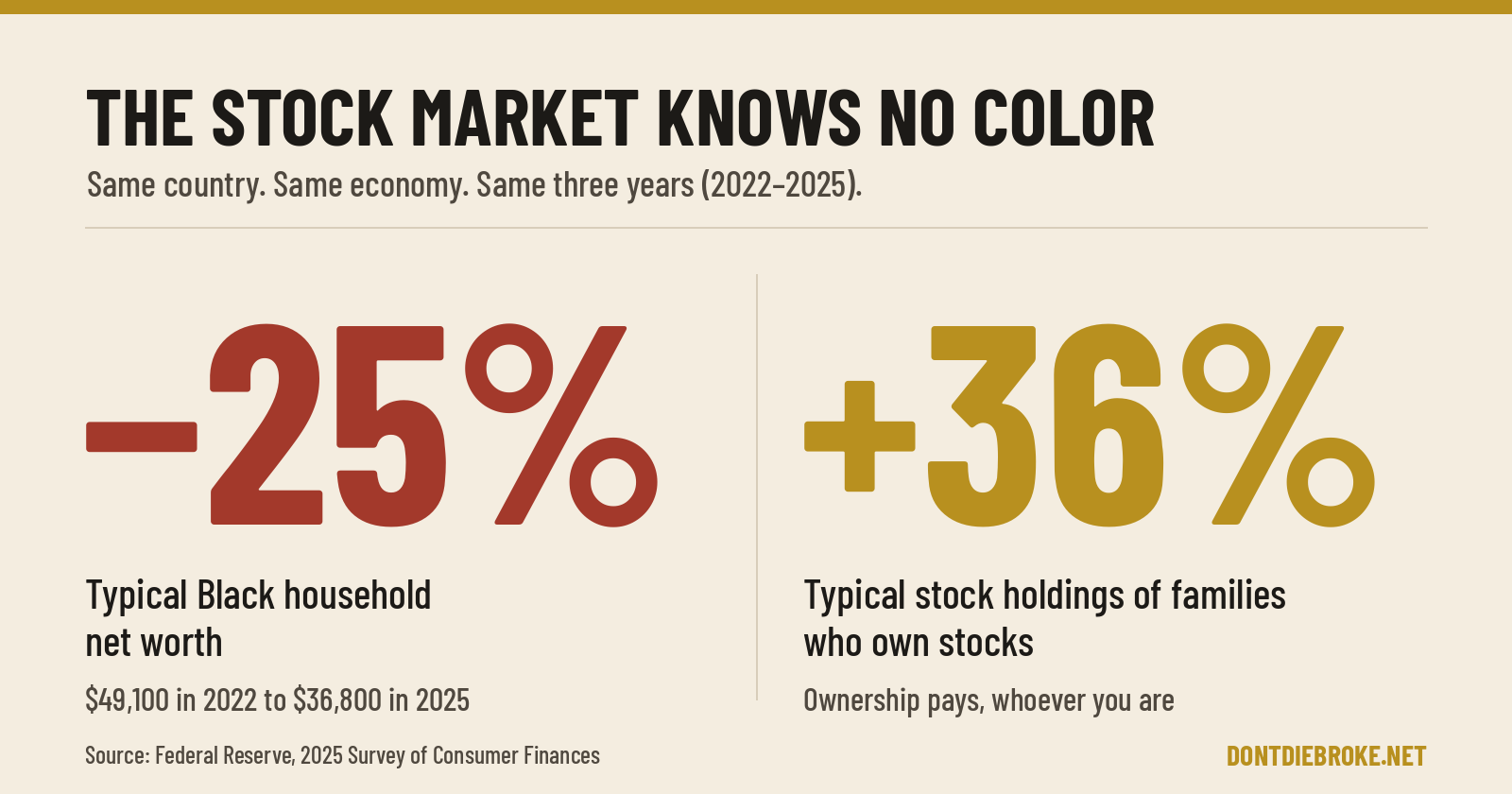
Source: Federal Reserve, 2025 Survey of Consumer Finances.
The Federal Reserve just released its 2025 Survey of Consumer Finances, and one number should stop every Black family in America cold.
The typical Black household's net worth dropped 25% in three years, from $49,100 in 2022 to $36,800 in 2025. White, Hispanic and Asian households all went up over the same stretch. The typical White family now holds roughly nine times the wealth of the typical Black family.
That's not a headline. That's a fire alarm.
What Happened?
Economist Algernon Austin at the Center for Economic and Policy Research broke down the numbers, and the losses showed up in the places most of us keep our wealth: the value of our homes, our cars and our retirement accounts. Fewer Black households owned things like real estate and vehicles at all.
Some context matters. Black median wealth had jumped about 60% between 2019 and 2022, so part of this drop is that pandemic-era bump unwinding. But context doesn't pay the bills. Going backward while everyone else moves forward hurts, period.
Now here's the number that didn't make most of the headlines.
Over those exact same three years, the Fed found that families who owned stocks saw their median stock holdings grow 36%.
Read that again. Same country. Same economy. Same three years. One group's wealth shrank by a quarter. The people who owned a piece of the market grew theirs by more than a third.
The Market Doesn't Know Who You Are
When you buy a share of an S&P 500 index fund, nobody asks your race. Nobody asks your zip code, your last name, or where you went to school.
There's no appraiser to lowball it. No loan officer to say no. No interview. No dress code.
Your $50 earns exactly the same percentage return as a billionaire's $50. Not a penny less.
But Let's Be Honest
The market knows no color. Access to the market has always known color.
Who got taught this at the kitchen table. Who had money left over at the end of the month. Who had a parent with a brokerage account and who had a parent with a payday loan. Federal Reserve research has shown for years that Black families are less likely to own stocks at all. That's the real gap, and it isn't about talent or intelligence.
You're not bad with money. You were never taught the game. And the good news is that knowledge is the one part of the gap you can close yourself, starting today.
Don't Wait for a Rescue
Austin's piece argues that Black families shouldn't expect help from the current administration and will need to look to states, cities and nonprofits instead. You can agree or disagree with his politics. Either way, the lesson is the same: waiting on Washington is not a financial plan. Not this administration, not the next one.
Policies change every four years. A share you own stays yours.
What to Do This Week
Wealth doesn't start with a windfall. It starts with a decision, and this is a good week to make it. That's exactly what How to Die Broke: You're Not Bad with Money. You're Being Played. walks you through. Inside, you'll learn:
- Where to go to simply begin investing. No gatekeepers, no big balance required.
- The steps to follow, starting with $5 or less. Pocket change is enough to get in the game.
- How to start the conversations that build generational wealth. With your parents, your partner and your kids, so one household's habit becomes a family legacy.
We're not giving away the recipe here. That's what the ebook is for.
See it for yourself first. Plug in what you could invest each week and watch what time does to it with our free Compound Interest Calculator. Five minutes with it might change how you look at every dollar you spend.
The Bottom Line
The stock market won't close the racial wealth gap on its own. But it will never refuse you service.
The Fed will run this survey again in three years. Let's make sure the next number tells a different story, one household at a time.
Todd Borom and his father, R.L. Borom, are the authors of How to Die Broke and Don't Die Broke. R.L. didn't start seriously investing until he was 82. He's 93 now, and still at it. The father-son team has been featured on Black Men Sundays, with an appearance on Someone Has to Be Brave coming soon.

About the hat: 330 is an Ohio area code. I wear it, red and all, when I drive through certain parts of the country. I was once pulled out of my car on I-80 while doing 50 in a 55, then made to stand on the shoulder for 30 minutes with traffic whizzing by. The reason I was finally given? Following a logging truck too closely. No ticket. I hadn't broken a single law, and I haven't forgotten it. Out on the road, people still decide who you are by how you look. The market never has.— Todd
Sources: Federal Reserve Board, 2025 Survey of Consumer Finances (released Oct. 9, 2026); Algernon Austin, Center for Economic and Policy Research (Oct. 13, 2026).
This post is for educational purposes only and is not financial advice. All investing involves risk, including loss of principal.
From R.L. & R.T. Borom
Learn where to start, with $5 or less
How to Die Broke: You're Not Bad with Money. You're Being Played. shows you where to begin, the steps to follow, and how to start the family conversations that build generational wealth.
Get the eBook — $9.99Try the Compound Interest Calculator